

Bra sizing can be really confusing when you're shopping from overseas. A 12C in Australia is generally the same as a 34C in the US or UK, and around a 75C in Europe — but the letters can start to drift apart once you get into bigger cup sizes. If you've ever ordered a bra online and had it come back wrong, this is usually why. It's one small piece of a much bigger puzzle, which we cover fully in our guide to underwear and lingerie sizing.
What's the Quickest Way to Convert Bra Sizes?
The best way is to sort out your band size first, using a chart like the one below, and then check the cup size for that same sizing system. Band numbers convert fairly reliably between countries. Cup letters are trickier, especially in bigger sizes, so it's worth checking the exact brand's own chart whenever you can, rather than guessing from a general rule.

Why Bra Sizing Isn't the Same Everywhere
Band sizing changes name depending on where you are, even though the actual measurement behind it is the same. Here's the general pattern:
-
UK and US use the same band numbers as each other (28, 30, 32, 34, and so on).
-
Australia and New Zealand use smaller numbers for the exact same band size — an AU 12 is the same fit as a UK/US 34.
-
Europe uses its own number system too, based on your under bust measurement in centimeters.
So the differences you see aren't random — they're just different ways of labelling the same measurement. Once you know the pattern, converting gets a lot easier. This is also one of the clearest examples of how brand sizing varies so much, because on top of the country differences, individual brands often have their own quirks too.
Bra Band Size Conversion Chart
Band size is the most reliable number to convert, since it's based on a straightforward under bust measurement.
|
AU/NZ |
UK |
US |
EU |
|
6 |
28 |
28 |
60 |
|
8 |
30 |
30 |
65 |
|
10 |
32 |
32 |
70 |
|
12 |
34 |
34 |
75 |
|
14 |
36 |
36 |
80 |
|
16 |
38 |
38 |
85 |
|
18 |
40 |
40 |
90 |
|
20 |
42 |
42 |
95 |
|
22 |
44 |
44 |
100 |
|
24 |
46 |
46 |
105 |
Keep in mind this is a general guide. Most mainstream brands follow it closely, but it's always worth double-checking a brand's own chart before you buy, especially if it's your first time shopping with them.
What About Cup Sizes?
This is where it gets a bit less exact. Cup letters mostly line up the same way across AU, UK, and US sizing up to a D cup. After that, the systems start to disagree with each other, and by the time you're past a DD, it's genuinely hard to give one chart that works for every brand.
Here's a rough guide for cup letters up to DD:
|
AU/NZ |
UK |
US |
|
A |
A |
A |
|
B |
B |
B |
|
C |
C |
C |
|
D |
D |
D |
|
DD |
DD |
DD/E |
Past DD, cup labelling can vary a lot from brand to brand — some use E, F, G and so on, while others jump to double or triple letters. Rather than publish a long list that might not match the brand you're shopping from, our honest advice is: check that specific brand's own size chart once you're past a DD cup, since it's the only way to be sure.
It also helps to remember that a cup letter isn't a fixed size on its own — it's really a relationship between your band and bust measurement. A DD on a small band is a very different volume to a DD on a larger band. That's part of why cup letters alone can be misleading without the band number attached.
How to Measure Yourself for Bra Sizing
A proper bra measurement comes down to two numbers: your band (under bust) and your bust (the fullest point). Getting both, then comparing them, is what determines your size. For the full walkthrough, see our step-by-step guide on how to measure for bra size. As a quick overview:
-
Measure snugly around your ribcage, right under your bust, for your band number.
-
Measure around the fullest part of your bust, without pulling the tape tight, for your bust number.
-
Compare the two numbers against your local brand's size chart to find your band and cup.
A common rule of thumb says every inch of difference between these two numbers equals one cup size — but this is a rough US-style shortcut, not a strict rule. Australian and European brands often use centimeter-based charts instead, so it's best to treat any "inch-per-cup" method as a starting point, not the final word. When measuring, keep the tape flat against your skin. If you'd rather measure while wearing a bra, choose one that's well-fitting and doesn't have padding, so it doesn't throw off your bust number.
Does Sizing Vary by Style?
It can, though it depends more on the individual brand and fabric than the style name alone:
-
T-shirt and everyday bras are usually built for a predictable, consistent fit.
-
Plunge and balconette styles sometimes run a little different in the cup because of their shape, though this isn't true for every brand.
-
Bralettes and wire-free styles are often sized in general S/M/L rather than band and cup numbers, which makes them less precise — checking the brand's own bust range is worth doing here.
-
Lace and delicate fabrics can behave differently depending on their exact stretch and construction, so it's worth checking the fabric details alongside the size chart rather than assuming based on style alone.
Does Fabric and Construction Affect Fit?
Yes, though it's more about the whole garment than any single part of it. Underwire adds shape and structure, but the wire itself isn't what stretches over time — the band, elastic, and fabric around it are what tend to give a little with wear. That's exactly why getting an accurate band and cup measurement matters, even for underwire styles.
Wire-free and soft-cup bras rely more on the fabric for support, so fit can shift slightly as the fabric wears in. Lace and other delicate fabrics vary a lot in how much stretch they have, so two bras in your usual size can still feel different depending on what they're made from. Checking the fabric listed on the product page, alongside the size chart, gives you a much better idea of how a specific piece will actually feel.
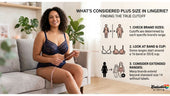
What Counts as Plus Size in Lingerie?
There's genuinely no single agreed definition here. Different brands set their own size ranges, and what one brand calls "plus" or "extended," another might treat as a totally standard size. Rather than relying on a "plus size" label, it's more useful to check a brand's actual size range directly. We go into this in more detail in our guide on what's considered plus size in lingerie, including how to shop confidently no matter where a brand draws that line.
Common Mistakes When Converting Bra Sizes
A handful of habits cause most sizing headaches:
-
Assuming AU and US band numbers are close together. They're not — an AU 12 and a US 12 are very different sizes, since AU numbering runs lower.
-
Relying on cup letter alone. Without the band number, a cup letter doesn't tell you much on its own.
-
Measuring over a bra that doesn't fit well, which can throw off both your band and bust numbers.
-
Assuming your size is fixed across every brand. Sizing genuinely isn't standardized, so checking each brand's own chart is always worth the extra minute.
-
Treating the inch-per-cup rule as exact. As covered above, it's a rough shortcut, not a guarantee — especially outside US brands.
If You're Between Two Sizes
If your measurements land between two sizes, it can help to try a nearby "sister size" — for example, going down one band and up one cup can sometimes give a very similar fit. This isn't a guaranteed rule though. Whether it actually feels better depends on the brand, the style, and your own body, so it's worth trying both if you're able to.
Buying Lingerie as a Gift
Sizing lingerie for someone else is trickier than most gifts, since you can't always ask directly or take a measurement yourself. Our guide on what size to buy when gifting lingerie covers this in more depth, but the short version: pieces that are adjustable and not too fitted, like bralettes or robes, tend to be a safer choice than a structured underwire bra. A gift receipt also makes it easy to fix the size later if needed.
Frequently Asked Questions
Can I just go by my usual clothing size instead of measuring?
Not really. Clothing size and bra size come from completely different measurements, so there's no reliable way to guess one from the other. Measuring is always more accurate than going off a dress or top size.
What if my measurements put me between two sizes?
Try both nearby sizes if you can, including a sister size (see above). There's no single right answer here — it comes down to what feels most comfortable and supportive for you.
Does bra size stay the same across every brand in one country?
Not always. Country-level charts are a good general guide, but individual brands can still differ, so checking each brand's own chart is worth doing, even if you already know your "usual" size.
How often should I get remeasured?
It's worth remeasuring roughly once a year, or any time your usual size stops feeling right — bra size can shift with weight changes and even how worn-in your current bras are.




 https://seductiveutopiaapac.com
0 comments