

Swimwear falls into a handful of broad categories for both men and women, from classic briefs, trunks and one pieces through to bikinis, tankinis and plus size styles, plus specialty categories such as enhancing and competition swimwear. This guide explains every major type in plain English, with a link through to a full, in depth guide for each one.
Shopping for swimwear can turn into a genuine research project once you start looking past the basics. Between different cuts, coverage levels, support features and fabric types, it is easy to end up more confused than when you started. This hub page is built to fix that. Below you will find a clear explanation of every major swimwear category for men and women, plus specialty styles like enhancing and plus size swimwear, each with a link to a dedicated guide if you want the full detail on that particular style.

None of these categories are mutually exclusive, and most people end up owning a mix depending on the occasion. A dedicated lap swimmer might own a competition brief or jammer for training, a pair of boardshorts for a beach holiday, and something entirely different again for a resort pool. Understanding what each category is actually built for, rather than treating swimwear as one generic product type, makes it far easier to buy the right thing the first time instead of ending up with a suit that looks right in a photo but is uncomfortable, unsupportive or impractical in the water.
Men's Swimwear Styles
Men's swimwear generally falls into five recognisable categories, each suited to a different combination of activity, coverage and support.
Swim briefs are the classic low rise, snug fitting style most people associate with competitive swimming, often nicknamed budgie smugglers in Australia. Speedo, an Australian brand founded in Sydney in 1914, introduced the design that shaped the modern brief in the 1950s, and it remains the standard choice for lap swimming and diving thanks to its minimal drag in the water.
Jockstraps started life as sports gear, invented in 1874 to protect cyclists on rough streets, long before the swimwear version existed. The modern swim jockstrap keeps the same supportive front pouch and open back design but uses quick drying, chlorine tolerant fabric, making it popular for pool parties, resort holidays and festival wear rather than everyday lap swimming.
Swim trunks are the most versatile everyday option, a mesh lined short with an elastic or drawstring waist that works equally well at the pool, the beach or a resort. Boardshorts are a longer, looser cousin built for surfing and watersports, with no mesh lining and a higher, more relaxed fit. Square cut swimwear sits between a brief and a boardshort, offering more thigh coverage than a brief with a close, streamlined fit.
G-strings, also called swim thongs, sit at the most minimal end of the scale, designed mainly for sunbaking and popular at resort, gay and Pride events rather than general swimming.
A related style worth knowing is the jammer, a knee length competitive suit that sits between a brief and full leg coverage, offering more muscle compression and thigh coverage than a brief while still remaining streamlined enough for racing. Jammers are common in swim squads and junior competition, where a full brief is considered too minimal for some clubs and pools.
For the full breakdown of these cuts, including fabric, sizing and brand recommendations, our men's swimwear style guide covers each style in detail. Since several of these cuts, particularly jockstraps and briefs, share their support technology directly with everyday underwear, our men's underwear style guide is a useful companion if you want to compare the two side by side.
Women's Swimwear Styles
Women's swimwear spans an even wider range of coverage and construction, largely built around a handful of core categories.
One piece swimsuits are the original foundation of women's swimwear, tracing back to Australian swimmer Annette Kellerman's controversial fitted swimsuit in 1907, and the modern version ranges from simple training suits to structured, supportive styles with underwire and shaping panels.
Bikinis were created in 1946 by French designer Louis Réard, who named the two piece style after Bikini Atoll, and remain the most flexible swimwear style available today thanks to the ability to mix and match top and bottom sizes.
Tankinis were invented in 1998 by American designer Anne Cole, combining a tank style top with bikini bottoms to offer more midsection coverage than a bikini while keeping the convenience of separates.

Swim dresses add a skirted panel over a one piece or bikini bottom for extra hip and thigh coverage, and high waisted styles, whether bikini bottoms or a high waisted one piece, offer more tummy coverage and a retro inspired silhouette.
Beyond these core categories, a handful of construction and neckline terms come up constantly when shopping for women's swimwear. A bandeau top is a strapless, straight across style, often paired with a separate tie or removable strap for extra support. A halter top ties or clips behind the neck, offering more bust support than a bandeau while still leaving the back bare. A racerback style uses a T shaped or crossed back strap for extra support during active swimming, and an underwire style uses a rigid wire beneath the bust for structure, in the same way an underwire bra does.
Our full women's swimwear guide covers all of these styles in more depth, including swim dresses and rash guard combinations.
What Is Enhancing Swimwear?
Enhancing swimwear refers to styles built with structured pouches, moulded cups or padding designed to shape or lift, rather than simply cover. For men, this generally means a shaped, structured front pouch in swim briefs, such as the technology Australian brand aussieBum introduced in 2006 with its Wonderjock design, which uses a shaped fabric cup rather than loose padding to lift and separate. For women, enhancing usually means a push up or padded bikini top, combining a moulded cup, graduated foam and often an underwire or powernet panel for structure and support.
Done well, enhancing swimwear looks natural rather than obvious, and the main factors that affect this are correct sizing, fabric structure and a proportionate amount of lift rather than the most heavily padded option available. Our dedicated guide on does padded or enhancing swimwear look natural goes into the mechanics and styling advice in full.
Plus Size Swimwear
Plus size swimwear is not simply a standard swimsuit made in a larger size. Good plus size construction includes reinforced seams, wider set straps, underwire or shelf bra support, and tummy control panelling designed specifically for a larger frame, and the category now offers the same range of one pieces, bikinis and tankinis as standard swimwear ranges. Australian labels such as Capriosca Swimwear and Curvy Swimwear, both based on the Gold Coast, have built dedicated plus size ranges around exactly this kind of construction, alongside international names such as Swimsuits For All.
Our full plus size swimwear guide covers construction details, sizing and brand recommendations in more depth, and since bust and cup sizing carries directly across from lingerie into supportive swimwear, our women's lingerie and bra fitting guide is a useful companion piece if underwire sizing is new to you.
Fabric and UV Protection at a Glance
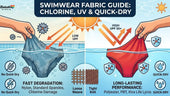
The fabric behind any swimwear style affects how long it lasts and how well it protects against sun exposure, and this matters just as much as the cut itself. Nylon is soft and comfortable but degrades fastest in chlorine, while polyester and polyester PBT blends are considerably more chlorine resistant and are the standard choice for competition and regular lap swimming. Specialty fibres such as Xtra Life Lycra, developed by The Lycra Company and used in swimwear since 2004, extend the life of stretch fabric significantly compared with standard spandex.
Sun protection is measured in Australia under the AS/NZS 4399 standard, which rates fabric using an Ultraviolet Protection Factor, or UPF, with 50+ representing the highest level of protection available, blocking at least 97.5 percent of UV radiation. Our full swimwear fabric guide covers nylon, polyester, PBT and specialty fibres in complete detail, including a full comparison table.
Getting Your Size Right
Swimwear sizing varies more between brands than almost any other clothing category, partly because Australia's old clothing sizing standard, AS 1344, was withdrawn in 2017 and never replaced, leaving brands free to set their own charts. The most reliable approach for any style covered on this page is to measure your own bust or chest, waist and hip with a soft tape measure, then compare those numbers against the specific product's own size chart rather than assuming your usual clothing size will carry across.
Our full swimwear size guide walks through exactly how to measure yourself for both men's and women's swim, step by step, and our broader guide on how underwear and swimwear sizing works explains why sizing differs so much between brands in more general terms.
Choosing Styles That Suit Your Body
Beyond the basic categories, most swimwear styling advice comes down to using colour, pattern and structure to balance your proportions, whether that means a belted one piece for an hourglass figure or a plain, well fitted brief for an athletic build. None of this is a rule about what anyone should wear, simply a starting point if you want one. Our full guide on the best swimwear for your body type covers specific style matching advice for both women's and men's body shapes in detail.
Swimwear for Special Occasions
Certain swimwear styles do double duty well beyond the pool or beach. Structured swim briefs, bikini tops and bodysuits have become genuinely popular festival and Pride event outfits in their own right, particularly paired with accessories, body paint or rainbow colours. If you are planning an outfit for an event like this, our guide on what to wear to a Pride parade or festival has practical advice alongside outfit ideas.
Certain swimwear pieces, particularly boardshorts, plain trunks and structured one pieces or bikini tops, have also crossed over into everyday fashion, worn as streetwear rather than strictly for the water. Our guide on wearing swimwear as everyday clothing covers which pieces work well this way and an important note on wearing clean, dry swimwear as an outfit choice rather than damp swimwear for extended periods.
A Short History of Swimwear
Understanding where these styles came from helps explain why they are built the way they are today. A few milestones stand out:
1874: The jockstrap is invented in Chicago to protect cyclists, decades before its swimwear crossover.
1907: Australian swimmer Annette Kellerman wears a fitted, one piece swimsuit on a Boston beach, sparking controversy and helping shift swimwear toward more practical designs.
1914: Speedo is founded in Sydney, later shaping the modern competitive swim brief.
1946: Louis Réard creates the modern bikini in Paris, naming it after Bikini Atoll.
1950s: Speedo introduces the design that becomes the standard racing brief, refined further by designer Peter Travis in 1959.
1998: Anne Cole invents the tankini in the United States, combining bikini bottoms with a tank style top.
2006: aussieBum launches its Wonderjock enhancing technology.
2011: Aquafil launches ECONYL, a regenerated nylon made from ocean and landfill waste, now used across parts of the swimwear industry.
2017: Australia's formal clothing sizing standard, AS 1344, is withdrawn without replacement, contributing to the size chart inconsistency shoppers still deal with today.
Brands to Know Across Every Category
A number of brands, many of them Australian, have shaped the categories covered on this page. Speedo remains the benchmark for competitive swimwear of any gender. aussieBum, Budgy Smuggler, Cocksox and Supawear are Australian labels known for men's briefs, trunks and enhancing pouch technology. On the women's side, Seafolly and Jets are long running Australian labels known for beach inspired prints and structured, supportive cuts, while Anne Cole remains closely associated with the tankini category it created. For plus size swimwear specifically, Capriosca Swimwear and Curvy Swimwear, both based on the Gold Coast, along with the United States label Swimsuits For All, have built dedicated ranges around genuine plus size construction rather than simply resized standard styles.
Caring for Any Type of Swimwear
Whatever style or brand you choose, a few care habits apply across the board and noticeably extend the life of any swimsuit. Rinse swimwear in cold water immediately after wearing it, whether in a pool or the ocean, to remove chlorine, salt and sunscreen residue before it sits in the fabric. Hand wash in a mild detergent rather than using a washing machine, which can stretch seams and damage support panels. Always avoid the tumble dryer, since heat is one of the fastest ways to break down spandex and elastane regardless of how chlorine resistant the base fabric is, and dry swimwear flat in the shade rather than direct sun to protect colour.
Common Mistakes When Choosing Swimwear
A handful of habits are behind most swimwear disappointments, regardless of which category you are shopping in. Relying on your usual clothing size rather than measuring yourself and checking the specific brand's chart is the single most common issue, since swimwear sizing is notoriously inconsistent between labels. Choosing a highly technical, competition focused fabric for occasional beach wear, or the reverse, a fashion focused nylon suit for serious daily lap swimming, both lead to disappointing durability or comfort down the track. Buying based purely on what a styling guide recommends for your body shape, without considering whether you actually like the piece, is another common trap, since personal preference and comfort should always outweigh generic style advice. Finally, skipping proper care, particularly rinsing swimwear after every wear and avoiding the tumble dryer, shortens the life of even the most expensive, well constructed suit.
Sustainable and Eco-Friendly Options
Sustainability has become a genuine consideration across most of the categories covered on this page, not just a niche add on. ECONYL, a regenerated nylon developed by the Italian company Aquafil and launched in 2011, is produced entirely from nylon waste, including reclaimed fishing nets and landfill plastic, and is chemically identical to virgin nylon once regenerated. Producing it reduces the global warming impact of nylon by up to 80 percent compared with virgin, oil derived nylon, and brands including Speedo and Adidas now use it across parts of their ranges. If sustainability matters to you as much as style or fit, it is worth checking a garment's fabric composition specifically for recycled or regenerated content rather than assuming any particular brand or category is automatically more sustainable than another.
A Quick Decision Guide
If you are still not sure where to start, a few common scenarios point toward an obvious category. For serious lap swimming or squad training, a polyester or PBT brief, jammer or one piece will outlast a fashion focused nylon style by a wide margin. For a beach holiday or resort stay, boardshorts, trunks, bikinis and tankinis in a nylon spandex blend offer the most comfort and style variety. For extra sun coverage, rash guards and long sleeve swimwear can offer practical protection without sacrificing proper swimwear construction. For extra bust or midsection support, whether due to body shape, post surgery recovery or simple preference, underwire, shelf bra and tummy control features found in enhancing and plus size ranges are worth prioritising over a basic soft cup style. For festivals, Pride events or general sun lounging, more minimal or decorative styles such as g-strings, structured bikini tops or printed briefs are built with exactly that context in mind rather than serious swimming.
Frequently Asked Questions
What are the main types of swimwear for men?
The main categories are swim briefs, jockstraps, swim trunks, boardshorts, square cut swimwear and g-strings, each suited to a different balance of coverage, support and activity, from competitive lap swimming to resort and festival wear.
What are the main types of swimwear for women?
The main categories are one piece swimsuits, bikinis, tankinis, swim dresses and high waisted styles, ranging from full coverage to minimal, plus specialty categories such as enhancing and plus size swimwear.
What is enhancing swimwear exactly?
Enhancing swimwear uses structured pouches, moulded cups or padding to shape and lift rather than simply cover the body. For men this usually means a structured swim brief pouch, and for women it usually means a push up or padded bikini top with moulded cups and support panelling.
Is plus size swimwear just a bigger version of standard styles?
No. Well made plus size swimwear includes specific construction features such as reinforced seams, wider straps, underwire support and tummy control panelling, designed for a larger frame rather than simply scaled up from a smaller pattern.
How do I know which swimwear style is right for me?
Start with how you plan to use it, whether that is serious lap swimming, beach days, festival wear or general sun protection, then narrow down by body shape and personal style preference. Our guides linked throughout this page cover each of these angles individually if you want more detail before deciding.
What is the difference between a jammer and a swim brief?
A swim brief is a low rise, minimal cut style offering the least fabric and drag in the water, while a jammer extends down to the knee, offering more muscle compression and thigh coverage. Both are used in competitive swimming, with the choice often coming down to personal preference, club rules or the specific event.
Is there a swimwear style built specifically for sun protection?
Yes. Rash guards, swim shirts and long sleeve one pieces are built with more fabric coverage than standard swimwear, and many carry a specific Ultraviolet Protection Factor rating under the AS/NZS 4399 standard, offering measurable sun protection rather than just extra coverage.
Do these swimwear categories apply the same way in Australia as overseas?
The core categories, such as briefs, trunks, one pieces and bikinis, are recognised internationally, though naming conventions and sizing can vary between countries. Australian slang terms such as budgie smugglers for swim briefs are locally specific, and Australian sizing tends to sit closer to UK sizing than US sizing, though checking actual measurements against a brand's own chart is always more reliable than assuming a size conversion.
Can swimwear styles be worn interchangeably between genders?
Increasingly, yes, particularly with unisex leaning styles such as boardshorts, rash guards and simple trunk cuts. Structured, gendered styles such as underwire bikini tops or traditional swim briefs are more specifically built for a particular body type and support need, though there is no rule against wearing whichever style fits and feels right for you.
Whatever style, size or level of coverage you are after, there is a genuine swimwear category built for it, and the detailed guides linked throughout this page cover every angle in full. Ready to see what is available? Shop swimwear and put everything covered here into practice.


 https://seductiveutopiaapac.com/blogs/the-utopia-edit/
0 comments